Literature Review
Written by Robin, Sarah, and Sara
Introduction
Artificial intelligence has existed longer than we know. It was first formally introduced in 1956 at the Dartmouth Conference, where the term artificial intelligence became official. However, its existence was already being discussed in the 1940s, when it was referred to as “thinking machines.” AI’s popularity has skyrocketed in the recent few years because it was no longer a discrete tool that was rarely used. Instead, it became easily accessible with the introduction of platforms such as ChatGPT. As a result, AI is now being integrated into the daily lives of people, and more specifically, into the daily lives of adolescents.
With the advent of newer AI tools, and specifically generative AI, we have a much easier way to access information. Generative AI (also called GenAI) can be utilized in nearly every environment ranging from at home to the workplace, and for the topic of this literature review, the schoolplace. Students as early as 12 years old utilize GenAI to assist them with learning in the classroom, homework, and even on certain class assignments. However, a discussion arises when we take into account whether or not an adolescent’s cognitive function is at risk due to the daily use of AI. On one hand, research and experiments support the inclusion of GenAI into the schoolplace as adolescents receive personalized, instant feedback, perform better in executive cognitive function, and display a higher level of motivation. On the other hand, devastating negative effects on an adolescent’s cognitive function arise due to AI.
AI was no longer simply an aid and is now shifting into a strong influence on cognition and cognitive function. During the ages of 12–18, cognitive development shifts toward the development of executive functions such as attention control, working memory, planning, and inhibition. During this period, there is heightened neuroplasticity and an increased importance of consistent cognitive use to strengthen neural pathways. Because cognition advances greatly during adolescence, there is growing concern about the long-term effects of daily AI use during this critical period in a child’s life. For these reasons, this literature review hopes to answer the question of what effect does the daily use of AI have on the human’s cognitive function over time on adolescence?
Adolescent Cognitive Development
The period between pre-teen years and adulthood represents a prolonged neurodevelopmental phase. During this time, there is continued maturation of the prefrontal cortex into early adulthood. The prefrontal cortex is the most forward part of the brain and is responsible for functions such as planning, decision-making, personality, coordinating thoughts, and overall cognitive regulation, often described as the brain’s “CEO.” It is the final part of the brain to fully mature, typically around the age of 22 for females and approximately 25 for males.
Brain maturation follows a progression that begins with basic functions, such as sensory and motor processing, and gradually advances toward more complex processes like abstract thinking and decision-making. Infants and toddlers exist at the earliest stages of this process, initially developing sensory and motor skills through their hands and mouth. In order to develop familiarity with objects, infants often use their mouths, as this area contains a high concentration of sensory neurons developed through feeding during infancy. This process allows them to form early knowledge about objects and their properties.
After this skeletal structure develops and the brain continues to mature with age, children gradually gain the ability to engage in more complex cognitive processes. During adolescence, neuroplasticity becomes especially heightened. Neuroplasticity refers to the brain’s ability to reorganize itself by forming new neural connections and pathways throughout life, allowing it to adapt, learn, recover, and modify functions in response to experiences. Essentially, the brain is able to rewire itself based on repeated stimuli, strengthening existing circuits while also creating new ones through challenge and environmental enrichment.
Neuroplasticity is especially important because it relies on synaptic plasticity, which involves the strengthening or weakening of connections between neurons. During this process, neurogenesis occurs, in which new neurons and nerve fibers grow and form new connections. What is especially important about these neural pathways is that they operate under a “use it or lose it” system. Pathways must be strengthened through repeated thinking, feeling, and doing activities that provide cognitive stimulation. When these pathways are used infrequently, they weaken and can eventually be lost. This mechanism is fundamental to learning and skill acquisition.

The image on the left shows what occurs in our brain when brain cells form new connections. The image on the right shows neurons stretching and growing to reach out and connect to each other. This happens when our brains form intricate networks for connections and allows for the existence of learning and memory.
Daily AI use has the potential to inhibit the brain’s natural processes of strengthening and development, particularly during the stages of life when the brain is building and learning the most in preparation for adult decision-making and cognitive function. Artificial intelligence impedes metacognition, which is still developing during adolescence, and may interfere with synaptic pruning that is necessary to strengthen efficient neural pathways. When these processes are disrupted, learning and growth become limited. When humans are unable to effectively learn and grow, they are more likely to rely on what feels familiar and accessible, such as search engines and AI systems that provide immediate answers. As a result, stagnation in skill development may increase dependence on AI for future cognitive thinking, reinforcing reliance rather than independence.
Pre-AI Cognitive Function in Adolescents
Pre-AI, there were already concerns about the effects on cognition, not due to artificial intelligence, but due to internet use and phone usage. Early research was conducted studying the effects of digital media, smartphones, and multitasking on cognitive function. The rise of smartphones and constant internet access created a shift from minor and occasional technology use to continuous digital engagement and entertainment. This shift greatly impacted adolescents, especially because algorithms are designed to target their interests, which directly affects attention span and focus. These changes also raised concerns about content exposure and the types of content being consumed. The internet became increasingly addictive due to personalized feeds that reinforced constant use and encouraged rapid information consumption. A clear example of this can be seen in modern-day social media. When scrolling through a social media feed, information is presented quickly and is catered to individual interests which can shorten attention span and make it more difficult for the brain to maintain focus on longer and more demanding cognitive processes. This pattern of constant stimulation leads to a concept known as “cognitive overload,” which occurs when the brain receives more information or tasks than working memory can effectively handle. Cognitive overload can result in mental burnout, poor learning outcomes, and difficulty retaining or processing information. In academic settings, research has shown increased distractibility associated with social media use, as attention is frequently diverted away from studying and sustained cognitive engagement.
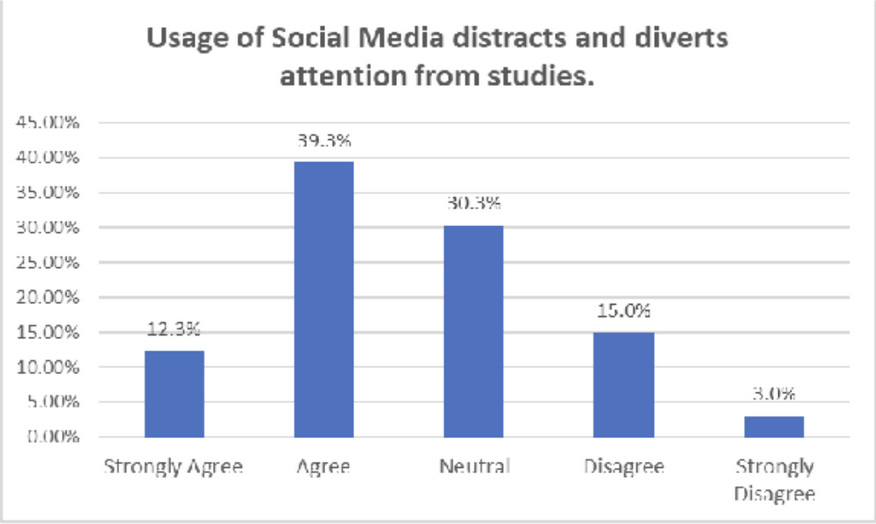
This graph shows a study on the effects of social media use on health and academic performance among students at the University of Sharjah. Students were asked to fill out a survey, and the percentages plotted represent their responses. About 40% indicated that they agree with the statement presented but there are concerns regarding the accuracy and validity of these results. Because this study relies on self-reported survey data, there is a possibility that participants may not have been completely truthful or may have misrepresented their responses.
How Does This Affect Post-AI
With the existence of social media and the internet already acting as a distractor and contributing to cognitive decline, the addition of AI further intensifies this pre-existing concern. With algorithms already in place and attention span continuing to decline, the easily accessible use of artificial intelligence reinforces the mental shortcuts that were developed through social media use. This increases reliance on external systems for thinking and causes the rate at which information is consumed to speed up, producing an even more severe form of cognitive overload. When attention is not maintained over a consistent length of time, this affects the future sustainability of attention and increases overall distractability. Over time, this pattern reinforces quick consumption rather than allowing active thinking and deeper cognitive engagement to occur.
AI Coaching Positive Effects on Adolescents
Despite concerns about AI’s potential negative effects on cognitive function, research suggests that AI provides certain positive benefits too, and in particular, towards adolescents. One study investigated the relationship between AI coaching tools and adolescent cognitive outcomes using a quantitative research design.The researchers collected numerical data to analyze how interactions with AI coaches related to executive functioning skills. The participants were all adolescents aged 12 to 18 years old with the setting being secondary schools. They were also divided into strata based on age, gender, and school type (public or private) to ensure “every subgroup was well [represented]” which in turn would reduce any bias. This diverse sample size leads to a more cohesive study. In specific, the study measured the frequency and intensity of adolescents’ interaction with AI coaching tools and examined their effects on cognitive skills such as attention, working memory, and self-control. The results showed a strong positive correlation between AI coaching and executive function, with a correlation coefficient, r-value, of 0.62 and a p-value less than 0.01. This indicates a statistically strong relationship that is highly unlike to have occurred by chance or coincidence.
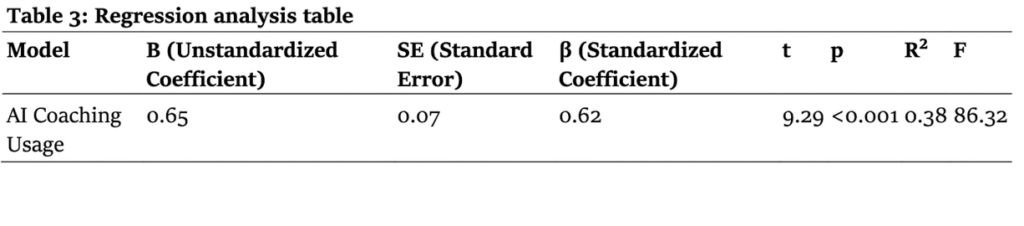
Additional statistical analyses further supported the researchers’ first hypothesis, which presented a positive relationship between AI coaching and executive function. The unstandardized coefficient (B) was 0.65, meaning that for every one-unit increase in AI coaching use, the executive function increased by 0.65 units. This value alone suggests a meaningful practical effect, not merely a small, negligible statistical one. The explained variance value, otherwise known as the R2-value, is 0.38 which means 38% of the variation with adolescent cognitive function can be explained by AI coaching. Though this may seem small and insignificant, in the real-world, this number means much of the “significant number of changes” can be “attributed to AI coaching”— in other words, AI coaching has a large effect size on an adolescent’s cognitive function. The researchers describe another form of analysis that was tested called ANOVA that compared executive function scores between adolescents who used AI coaching frequently and those who used it less frequently. They found out that there was a large difference between the two groups with an F-value of 25.60, a similar value to the previous regression model analysis where the R2-value was 0.38. This F-value indicates a large difference between the group who used AI coaching frequently versus those who didn’t and directly showed that those who did use it frequently had higher executive function development.
While these findings provide strong statistical evidence, the practical benefits of AI coaching become even clearer when considered in real-world contexts. These AI coaches offered “insights and real-time feedback on an individual level” in accordance with each learner’s specific strengths and weaknesses. AI’s ability to adapt to each student’s needs makes it more effective than compared to more conventional methods, such as tutoring, that often don’t provide such tailored support. Moreover, AI coaches also provide “motivation and engagement benefits” that not only improve an adolescent’s cognitive abilities, but also “have a positive effect on the emotional and motivational… the establishment of long-term learning practice.” Instilling both motivation and a foundation for continued learning. Additionally, the previously mentioned stratas during the methodology provided insight on the “potential of [AI coaching] to be functional under [those with] different social economic and educational backgrounds.” This versatility that AI brings across diverse backgrounds is only an added benefit to an adolescent’s cognitive function.
Another article utilizes a narrative literature review process for their methodology where they systemically examined and synthesized findings from other previously peer-reviewed published research papers and articles across neuroscience, cognitive psychology, and behavioral science when it came to AI. Because the authors integrated results from several different studies, they were able to provide a more thorough overview on how AI influences/affects adolescent cognitive function. Specifically, the article goes on to state how schools could implement “adaptive learning [AI] platforms” that “provide personalized learning… enhance learning outcomes.” These adaptive learning platforms also offer real-time feedback and reinforce “concepts” while also “[addressing] misconceptions immediately.” This level of quick-and-easy feedback allows adolescents to engage more deeply with academic material, improving comprehension and their retention of the material over time. Additionally, these AI tools can also analyze vast amounts of information (or data) and look for signs that would otherwise overwhelm human cognitive capacity, thereby supporting more informed and data-driven decision making. AI acts as a cognitive scaffold, in the sense that it reduces cognitive overload on an adolescent, and helps them manage complex tasks as well as build higher-order thinking skills.
The authors state more benefits from using AI with adolescents by giving certain examples. Duolingo, a language-model-based tool and mobile phone application, enables adolescents to practice language skills in a “non-judgemental environment,” adapting the content to its user’s performance and learning speed. This makes the time and comprehension of the language more efficient. Another example is AI-driven mental health tools, such as chat bots like Woebot, that provide “cognitive-behavioral therapy-based interventions,” which may improve an adolescent’s emotional well-being and even influence regions in their brain that are associated with emotional regulation, including regions such as the prefrontal cortex and amygdala which are key controllers for that. Since adolescence is such an important period in a person’s life for emotional and executive development, these tools can support emotional awareness, stress management, cognitive resilience and above all improve their cognitive function.
From these two sources, we see a clear connection between AI coaching tools and applications and an adolescent’s cognitive function. The adolescent seems to improve in more ways than one: their emotional, mental, cognitive and behavioral health all improve with the addition of AI coaching. In both studies, we see AI coaching providing real-time feedback which is one of the main reasons why it provides such great benefits. The customization AI coaching provides as well with its diversity capabilities also ensures any kid, regardless of socioeconomic status, has access to AI coaching’s benefits. However, there seems to be an apparent gap in these sources’ findings and it’s that one of them looks at a specific age gap of 12 to 18 years old, whereas the other one talks generally about “students” and does not directly give an age range. This may be due to the second source being a literature review from multiple different studies and papers, and thus couldn’t accurately define an age range for the article. Nevertheless, for future studies on this topic, an age range should be defined and should be stated clearly within the first few paragraphs. Additionally, looking at AI coaching for home-schooled children could be a potential route for this topic since home-schooled children and school children tend to have different cognitive functions: one develops it by being in their home the other develops it by being at school. It would be interesting to see the interactions and effects AI coaching has on that.
Reviewing Sources
The source “AI as a Cognitive Collaborator” by Min Jae Park is a reliable source because he is a professor in Business and Intelligence at Ajou University, and this article is also published in a peer-reviewed academic journal, and it’s written by an expert in innovation and technology. The author supports their ideas by using a randomized 2×2 field of experiment with a large sample size of 371 working professionals, and this strengthens the credibility of the findings that they have in this study because they have evidence to support their claims, and it makes it easier to trust. The study used multiple methods like surveys, behavioral data, expert evaluations, and interviews to make the study more trustworthy. A major strength that this study has is that it shows both the benefits of AI, like better innovation, efficiency, and emotional engagement, but he also talks about the concerns, like cognitive overload, anxiety, and over-reliance on AI. However, one limitation that this study has is that all the participants were adult professionals in South Korea, so the results may not apply to younger students or other cultures or people from different countries because this study only included people that are from South Korea. The research could be improved by studying students or adolescents or by using a longer time to see how their thinking and habits change over time, and to do this study with many people from all over the place and to use simpler words so that anyone reading it can understand what is being talked about. Overall, this source is easy to understand because it uses a clear theory of assimilation vs. accommodation and it also uses real data, and shows balanced results, but its age group and cultural focus limit how widely the findings can be applied.
The second article titled “The Impact of Digital Technology, Social Media, and Artificial Intelligence on Cognitive Functions” by Mathura Shanmugasundaram from Harvard Medical School and Arunkumar Tamilarasu is reliable because it is a peer-reviewed article, published in a respected academic journal called Frontiers in Cognition. The authors are credible researchers and support their ideas by reviewing many existing studies from psychology, neuroscience, and education rather than just focusing on one experiment which is helpful because it shows how digital technology, social media, and artificial intelligence affect people across different age groups and explains the psychological impact that these these technologies have on people. A strength of this article is that it compares their findings across different age groups, like children, young adults, and older adults, and this shows us the benefits of technology and AI, like learning support, efficiency, and accessibility for everyone. They also talk about their concerns, which are when these technologies affect people’s attention span, cognitive overload, and how it reduces critical thinking because people are relying on these tools to do the work for them. However, a limitation that this study has is that it does not collect new data and has no single sample size because this study only looks at past studies. Because this is a review article, the authors did not collect their own data and relied on past studies that other researchers did, but they analyzed these studies. This means that their conclusions depend on the quality, sample sizes, and age groups of the original studies, which limits how strongly they can explain the cause and effect relationships because they can not control how those studies were designed or who participated in them.
In “AI as a Cognitive Coach: Investigating Its Role in Enhancing Executive Function in Adolescents by Murk Nizamani, Maria Qureshi, Shazia Akram Janjua and Faiza Maqsood is a reliable source because it was written by researchers in psychology, education, and mental health and more. They also published this article in a peer-reviewed academic journal so it’s more trustworthy. The authors also supported their ideas by collecting real data from the 280 adolescents that participated in the study, from people aged 12 through 18, using a quantitative study and statistical analysis, which makes the results more trustworthy because there are facts that prove it. A strength of this study is its large and diverse sample and its focus on real cognitive skills like attention, memory, and self-control. Another strength is that it compares students who used AI coaching with those who did not, showing us the clear differences. A limitation is that the study focuses only on adolescents that are in school, so the results may not apply to younger children or adults that are working. The research could be improved by following students over a longer period of time to see if the effects are still the same. Another thing they could do is test AI coaching with college students to see if the effects continue as people get older.
The next source titled “Google Effects on Memory: Cognitive Consequences of Having Information at Our Fingertips” by Betsy Sparrow, Jenny Liu, and Daniel Wegner is a reliable article because it was published in a Science journal that is highly respected by many and its also peer-reviewed by many people. This article was also written by well-known psychology researchers. The authors supported their ideas by conducting four controlled experiments with adult participants to test how access to the internet affects their memory. A major strength of this study is that it uses experimental designs to see the effects of the internet on adults, which helps show the cause- and- effect relationships between technology and how it affects our memory. The findings clearly show a benefit and its easy access to information that’s available on the internet, and a concern that they had was how people remember where to find the information instead of actually remembering the contents that they learn. One limitation is that the experiment only included adults, not students or younger users of google, so the results may not apply to adolescents or children. The research could be stronger if it included younger age groups or examined long-term effects to see how constant internet use changes thinking over time and what it is used for and the effects.
The article “The Impact of Media Multitasking on Attention and Cognitive Control” is reliable because it was also written by cognitive psychology researchers, published in the National Library of Medicine, and peer-reviewed by other people. The authors also support their ideas by running controlled laboratory experiments that measured attention, task-switching, and focus in adults. This study uses objective cognitive tests instead of only surveys, which makes the results more accurate. The results that they got shows that heavy media multitasking is linked to weaker attention control, and it increases people’s distraction, showing us a clear concern about how technology affects people. However, one thing that this study needs is a more diverse age group because this study mainly experimented on young adults, so the results may not apply to children or older adults because they weren’t in the experiment, so we don’t know if they would have gotten the same results that the young adults got. The research would be stronger if it included different age groups or tried to do the experiment in a different way to see if the results are still the same.
Overall, all five sources are reliable because they were written by experts in there fields, and all these articles were all published in peer-reviewed academic journals, which shows how they are more trustworthy than other sources because they did their research and proved their findings. All Five sources look at how technology or AI affects how people think, remember, focus, and learn things. One thing that they all have in common in all five articles is that they show both the good and the bad effects of technology on people. The benefits that they listed were making work faster, having easy access to information, and learning support. However, the concerns that they found were that people started having weaker attention spans, memory problems, and people relying too much on technology instead of thinking on their own. The studies are different in how they were done. Some sources used experiments to directly test the participants’ memories and attention to see the effects that technology had on them. Others collected real data from students or workers, and another one source reviewed many past studies to compare results. They also studied different age groups, such as adolescents, adults, and professionals, which helps show that technology affects people differently depending on their age. Using all five sources together makes the research stronger because they support each other and give a clear and balanced understanding of how technology and AI affect the human mind.

