White Paper
Written by Robin, Sarah, and Carlos
Executive Summary
Systemic inequality is a rising issue among the workplace and in everyday life. This inequality could vary from wage gaps and severe price differentials for gender-based products, to sexual harassment and the imbalance of power between genders. In specific, pink tax is one form of systemic inequality. It is a taxation based on sex that is inherently misogynistic as it makes products geared toward women, like menstrual products, more expensive. This in turn leads to corrupt companies and making women impoverished, especially those from marginalized communities. Systemic inequality goes beyond pink tax as well, even developing into gender-based discrimination. This leads to sexual harassment, especially in the workplace, and prevents women from succeeding and oftentimes leading them to more worse financial situation and everyday social life. Our solutions to overcome this dilemma of systemic inequality revolve around bringing attention and awareness to this issue and to garner as much support as possible around the world. Eventually, with all this support you can reach policy and lawmakers to implement actual change.
Introduction
What is Systemic Inequality?
Systemic inequality can be defined as disadvantages to a particular group in society in its institutions, policies, and practices. Throughout history, these inequalities have been deeply embedded into every corner of society and have diversified to attack several vulnerable and marginalized groups such as people of color, queer youth, and young women. Specifically in over 97 countries, gender inequality remains an enduring and prominent issue. This issue stems from a country having a patriarchal society and especially one that has marginalized women throughout history to inhibit their access to education, political participation, and healthcare. In many countries in South America, for example, patriarchal systems have denied women their basic rights and access to resources. A prime example of this is pink tax. This is a form of gender-based (sexist) taxation, particularly by raising prices for products in high demand for women specifically, for women’s menstrual and reproductive products, but this tax applies to any product geared towards the gender itself. This taxation also leads to deprivation of access to healthcare, work, education, and even from “[participating] in public activities.”
Systemic gender inequality does not only exist within a workplace with a group of co-workers, it also exists within economic systems. Even though the struggles women faced aren’t as loud, it doesn’t mean that it doesn’t exist. In the context of systemic gender inequality, history did not repeat itself, but actually never changed. In 1963, the Equal Pay Act was created to halt the discrimination of workers based on their sex. President John F. Kennedy signed one of the first ever anti-discrimination laws that reflected the wage differences between men and women. According to the Center for American Progress, data has shown a $61,000,000,000,000 gender wage gap since 1967, that is 61 trillion dollars. While from then on, pay discrimination became illegal, it didn’t stop the motives of corrupt power-hungry companies from discriminating against women in aspects larger than a wage gap. The pink-tax is a marketing technique that big companies use to increase the prices of products or services catered to just women. Women not only earn less than men, but their products are also more costly causing this huge gap in financial status between men and women.
What is Pink Tax?
Pink tax is also a part of a larger framework that consists of gender-based discrimination and sexual harassment. In the workforce, women are more likely than not to face discrimination in the workforce through less working hours, higher recruitment standards, limited access to promotion, and above all being under-represented in professional roles. These issues are mainly due to a combination of a power imbalance from the patriarchal landscape and the lack of awareness being made for them. As a result, this white paper will explore the intricate relationship between gender inequality, gender-based discrimination, and socioeconomic status. More specifically, in the context of gender inequality and pink tax, this white paper will look closely at social equity and governance for solutions. We will examine various sets of data across companies and products and explore how these inequities can be addressed or challenged through potential policy solutions.
Problem Description
Wage Gap
For every 1 dollar earned by men, women earn less, and this gap leads to a long cliff jump of issues. Globally, estimations of price differences put women at roughly 77–84 cents compared to the 1 dollar a man earns, depending on country and method. In the United States, the commonly cited figure is about 82 cents compared to the dollar for full-time, year‑round workers. When you include part‑time and seasonal workers, it falls closer to 77 cents. The gaps are wider for many women of color: Black women in the U.S. earn around 70 cents and Latinas around 65 cents per white, non‑Hispanic man’s dollar. These cents‑on‑the‑dollar gaps translate into thousands of dollars lost annually and hundreds of thousands over a career.
The gender wage gap reduces women’s earnings across nearly every economy and career stage, and it supports the cost burden created by the pink tax. Globally, women earn roughly 16–23% less than men on average, and are less likely to be in higher‑paid leadership tracks due to lack of promotion, occupational segregation, and career interruptions tied to unpaid care. With less disposable income, a seemingly small 5–10% overcharge on women‑marketed products and services functions like a regressive surcharge on a smaller paycheck, widening lifetime wealth gaps. The wage gap also interacts with access: lower earnings mean tighter monthly budgets, which can push women toward lower‑quality or less frequent purchases of health, hygiene, and professional goods which are choices that can affect well‑being, productivity, and advancement.
Product Differentials
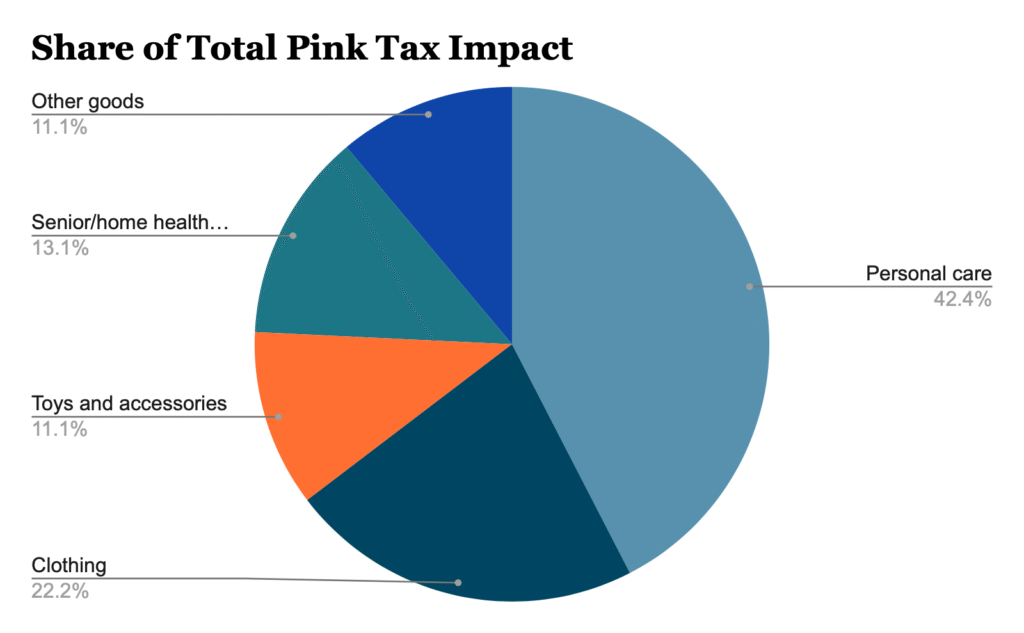
When you compare everyday consumer goods marketed to women versus men, you often find women paying more for essentially the same thing. Think razors, deodorant, shampoo, body wash, even basic T‑shirts. Across multiple audits (like the NYC “From Cradle to Cane” study and follow‑ups in the UK and EU), the average premium on women’s versions typically lands in the 5–10% range, with personal care frequently at the high end, sometimes 10–13%. The differences often come down to packaging, scent, and color rather than any meaningful difference in performance or ingredients. Over a year, that small percentage adds up. For a typical personal‑care basket, paying 8–10% more can mean dozens of extra dollars annually; over a decade, it’s hundreds. For lower‑income consumers, that overcharge hits hardest, functioning like a regressive, hidden surcharge for being a woman.
In a study done in July of 2025 by the National Library of Medicine, the average cost of topical minoxidil foams were noted down across various retail stores. The products were either geared towards men or women.
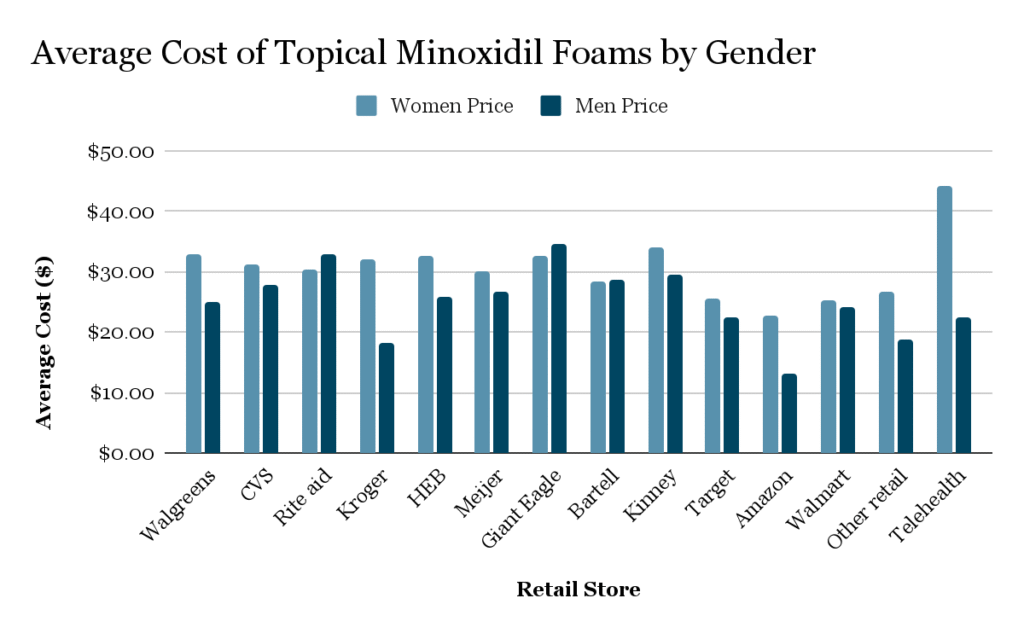
As seen in the graph above, the prices between men and women varied either by a small amount or a drastic amount. For instance, at Kroger, the product geared towards women costs over $30, $32.00, to be specific, meanwhile the same product but geared towards men costs less than $20, $18.11, to be specific. For some like Telehealth have a drastic difference with women paying nearly double the price that men pay. This price disparity in products is based solely on gender and is being exploited by companies to make women pay more for a product. This graph only speaks on topical minoxidil, but this same disparity can be found even in menstrual products that are taxed much higher.
Menstrual Products and Taxation
Menstrual and reproductive health products are essential, yet many jurisdictions still treat them as taxable non‑essentials. Where a “tampon tax” or standard VAT (value-added tax) applies, the rate can run 5–20%, directly raising the cost of pads, tampons, cups, and pain relief. Countries and states that have eliminated or reduced these taxes show immediate affordability gains and, when paired with free supply in schools and public facilities, measurable drops in school absences and work disruptions linked to period poverty.
The burden is not only financial; when products are unaffordable or unavailable, people miss class, cut work hours, or resort to unsafe substitutes, with ripple effects on health and income. Removing the tax, subsidizing access, and ensuring WASH (water, sanitation, hygiene) facilities are straightforward policy levers that improve dignity, health, and economic participation.
Service Price Differentials
It’s not just goods. Services marketed to women also tend to cost more. Dry cleaning and laundry have long been cited: a simple button‑down shirt cut for women is often priced as “specialty” or “hand‑finish,” pushing the cost 30–50% above a men’s shirt that’s nearly identical in size and fabric. Haircuts and styling show similar gaps, women commonly face higher base prices even for short, simple cuts comparable in time and skill to men’s services. Even in mobility and travel, there are instances where female‑focused offerings or add‑ons drive higher effective prices. None of this is inevitable; it’s a result of pricing rules, long outdated standards, and marketing choices that collectively create systematic over-payment to women for comparable service quality.
Sexual Harassment
Sexual harassment supports these disparities by influencing a woman’s safety and career continuity. Surveys across advanced and emerging economies found lifetime workplace harassment occurrences for women in the 30–60% range, with other reports often below 10–20% due to fear of retaliation, weak remedies, or cultural stigma. Harassment contributes to instability in a workforce and frequent absences, forces unwanted job changes, and blocks women away from certain sectors, shifts, or client‑facing roles, dynamics that suppress earnings and slow promotions, thereby reinforcing the wage gap. When combined with gendered price overcharge and taxes on essential menstrual products ,the negative effects of harassment on a woman’s job and earnings make financial problems worse, turning everyday consumption and participation in public life into higher‑risk, higher‑cost experiences. Anti‑harassment systems, safe ways to report harassment, and leadership accountability are therefore not just the right thing to do morally; they are essential to closing pay gaps and reducing the effective burden of the pink tax.
Solutions
Attention to the Issue
A pattern seen commonly with how people in the articles seem to try and solve the issue of the pink tax/ other gender based wage differences is, in simple terms, really just getting that information out there. Bringing attention to the issue brings scrutiny to the companies that impose this tax and to other companies, even across the world, where people are mobilizing on their unequal pay and unfair tax on women’s goods in comparison to men’s.
Worker Unions in relation to Women’s Pay at the Workplace
Starting off, companies, despite their efforts to downplay Unions in recent times, are at their weakest when influenced by one. Feminist movements, as well as other movements in relation to workplaces and pay, result in unionization as a group of people and demand change in their pay. A Grand example of a union’s success in recent history to look at is the Hollywood Writers’ strike, known as the Writers Guild of America (Kinder) which fought against Hollywood’s rampant use of AI to try and replace their writers and actors of which, decided to fight back by unionizing against Hollywood and in a positive twist had actually won and got on negotiating terms against Hollywood. Unions, as exemplified before, work best when attention is brought to both the people working in the company and those who aren’t and could be primarily consumers of the product on offer.
Things along the lines of this, regular people, for the most part, can do the following:
- Spread the word of popular unions of this sort. Try making a Video or Speech to a larger crowd of people and get information out there about unions, all about the wage gap, or get more people to research them by posting about it online, either through forums or social media sites (and try to be reasonable and civil).
- Make more positive light of unions, not many people in recent online culture believe in the power of a unionized mass, so try and share stories of those unions that have worked. (Unions in recent examples like the Writers Guild of America).
- Convince Coworkers, or others in other companies, to work with or within the Unions. A regular method for unions to get more press is to make the union larger.
Support Movements To Reshape the World
Adjacent to the lot of these solutions are generally within the category of Feminist Movements. These movements are, as read in the lot of our Articles, a very important part of making a difference in Menstrual taxes across the world, and as seen in the article on Taxing Women’s Bodies: the State of Menstrual Product Taxes in the Americas by Alhelí Calderón-Villarreal, Movements have made for a most part in several states in America taxless on menstrual products and such. As well as on the same graph in the article, denoting other areas around the world, generally on how they’ve taxed menstrual products. Same as the other solutions, Regular people can help feminist movements by doing relatively simple things, like what follows.
- Joining a Movement/ Rally happening in your local area. Marches and protests also mean a lot to join; don’t be afraid to enter and support the cause. Fear can limit how effectively a group can push forward.
- Find other Movements online that are currently fighting against the Pink Tax in your state. Movements are likely mobilizing in these areas currently, so if you can try and see if you can share interest in these movements online to bolster more to join and protest.
- Perhaps get in contact with more Movement leaders around the globe and ask them to pursue more change in terms of the pink tax in their country or state. As seen in the article’s graphs, many parts of the world suffer from different amounts of taxation for menstrual products
Using Political Influence and Lawmaking to Make Permanent Change
The most powerful tool in most scenarios to make a permanent change in something is to Enstate it. Laws are the most extreme tool in many scenarios, especially for companies that aren’t doing what the voters would stand for. Throughout history, and even till today, laws, when put in practice, have a fundamental change on how companies operate, and feminist movements can and have had an effect through fighting for certain bills to reach Congress. One such law that has been in effect for worker protection is the National Labor Relations Act (NLRA) (National Labor Relations Board), which ensures that you can, in any situation, discuss your wages overall, making the act of Unionizing Easier. In more specific terms, you can influence the lawmaking process.
- Look to support congressmen and politicians who look to change wage differences. Vote for the politicians or local governors that you can confirm know of and seek to address the Pink Tax and gender based Wage gaps.
- Write to your congressmen to get a bill started that looks to address and maybe do something about the pink tax.
- Inform local governors and vote for the right candidate for your city or the country that will make more headway into minimizing the Pink Tax and the inequality of wage inequality between genders.
Pink Tax Bill
The proposed bill suggests that any company residing from, or within America has to tax appropriately with their products, this affects all products of which are for personal health and hygiene. Products include and are not limited to, menstrual products, conditioner/bathing products that are applied to the skin, odor products, medicinal herbs, medical supplements, and products marketed to be for health/hygiene. Federal taxes still apply onto these products however additional taxes such as taxes based on the gender of the consumer are explicitly outlawed and must stay within fair pricing of the object in general as of accordance with the FTC. Companies will not be allowed to raise or lower the pricing of the product to adjust to a lack of a tax in relation to the current law as seen here, doing such will call out for an investigation from the FTC and other bureaus alike. The products on sale are monitored by the FTC and soon to be created by the Fair Pricing Commission (FPC), allowing the products to rise in value only in accordance with inflation, rising tariffs, and or global pricing. Until sufficient progress has been made between the FTC and FPC the prices will stay at their current level until further notice. Additionally, companies in America are subject to report and document their pricings to the FPC over time bi-monthly. If the reports are flagged by the FPC and FTC, the company in question will have to be investigated by the FTC for fraudulent taxation of health/hygienic products resulting in a fine of 15% of their monthly revenue and if not compliant for the changes recommended by the FPC they will be confiscated of their total earning for the next month and foreseeable month upon check of the FTC and FPC if not corrected.
This bill, as already stated, supports the creation, operation, and funding of a dedicated commission on affairs related to fair pricing called the Fair Pricing Commission (FPC). The FPC will thoroughly examine company pricing reports and ensure any affairs regarding gender-based taxation and any unfair pricing will be addressed directly heads-on. To maintain consistent oversight, the FPC will meet once a month to review submitted company reports, determine patterns of concern, and decide on which one to investigate further if necessary. Any company that does not submit their mandatory monthly report will be held accountable and may receive consequences. Beyond oversight, this bill also provides the FPC the authority to enforce gender-neutral pricing policies that will encourage (and may even require) companies to price products equally regardless of their target audience. Failure to oblige to the authority of the FPC will result in the company receiving formal sanctions or the loss of 15% of their total revenue for that month.
The bill also introduces an annual, nationwide survey that’s designed to assess the public’s perception of fair pricing across a wide variety of products and services. This survey will be classified as a federal report and the data will be collected, evaluated, processed, and responded to by the FPC who will not only enforce their policies on any company that has unequal tax, but use their findings to identify areas where consumers consistently report unfair or gender-based pricing and ensure transparency between those companies, the FPC, and above all the consumers. Similarly, the FPC will require companies to ask their own surveys to their consumers about the fairness in pricing and then send that report to the FPC for review. The combination of the annual report and each company’s survey will create a feedback loop in which consumer experiences will directly inform policy enforcement from a nationwide scale and a local, citywide scale as well.
Lastly, this bill calls upon the compliance and alliance of the Federal Trade Commission (FTC) to form a partnership between the FPC and them. As it stands right now, the FTC holds a higher level of authority than the FPC and because of this, we think it is not only viable but smart to coalign their efforts and create a stronger commission. Additionally, this bill hopes to aid in the FTC’s dedication and commitment to investigating already-existing company reports that have unreasonable and unfair prices. The FPC will honor this level of work and follow FTC’s footsteps. This bill proposes not just the partnership between the FPC and the FTC, but for the FPC to receive access to national market data, legal expertise, and the clearance for the FPC to operate on independent investigations. Together, they would share relevant findings and coordinate next steps to ensure enforcement against unfair pricing and consumer protection.

